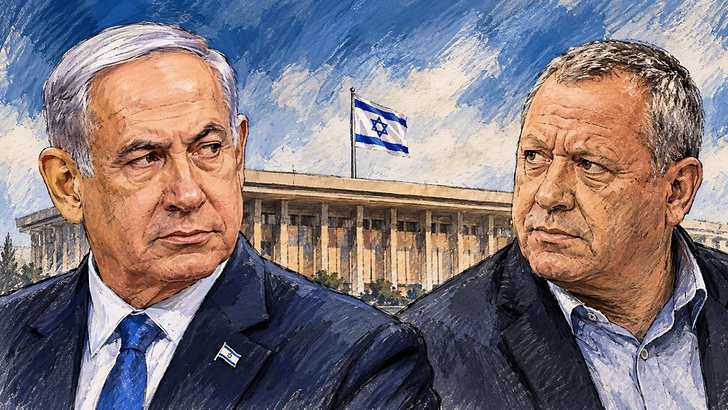
Nearly four weeks after Israel’s October 27 election, the country still does not know who will be its next prime minister. Benjamin Netanyahu remains caretaker prime minister while his main rival, former military chief Gadi Eisenkot, tries to assemble a coalition in a deeply divided 120-seat Knesset.
Who could be next PM?
The most likely next prime minister is Gadi Eisenkot, the leader of the Yashar party and the politician formally tasked by President Isaac Herzog with forming the next government. But he has not yet secured the 61-seat parliamentary majority needed to take office.
Eisenkot’s anti-Netanyahu bloc holds 48 seats, while Netanyahu’s bloc has 53. Neither side can govern alone, so the Arab-majority parties whose 19 seats could provide outside support have become decisive.
Possible outcome What it means
Eisenkot minority government Eisenkot becomes PM with a 48-seat cabinet, relying on Arab-majority parties for support on key votes. Coalition with ultra-Orthodox parties Eisenkot could reach 61 seats by bringing in Netanyahu-aligned ultra-Orthodox parties, though this would require major compromises. Netanyahu-Eisenkot unity government The two rivals could share power, but the central unresolved issue is who would serve as prime minister.
Another election If neither leader can form a government by the legal deadline, Israel could return to the polls.
Why Netanyahu is still PM
Netanyahu is still in office because Israel has a caretaker government during coalition negotiations. A prime minister does not automatically leave power after an election; he remains in the role until the Knesset approves a successor and a new government is sworn in.
Although Netanyahu’s bloc won the most seats 53 against Eisenkot’s 48 he lost the parliamentary majority that had sustained his government. He therefore cannot form a government on his own, but he can still influence negotiations and push for a unity arrangement that would keep him in a leading role.
Why the delay?
The delay is not unusual in Israel’s
proportional-representation system, where no single party usually wins a majority and governments are built through coalition deals. But this negotiation has been especially difficult because the parties needed to make a majority disagree on fundamental issues, including whether to rely on Arab-majority parties.Eisenkot’s main obstacle is Avigdor Liberman, whose Yisrael Beiteinu party refuses to join a government dependent on Arab parties. Liberman argues that such a minority government would be unstable and would ultimately strengthen Netanyahu.
At the same time, Eisenkot is negotiating with ultra-Orthodox parties from Netanyahu’s traditional bloc, while Netanyahu is pressing for a broad national-unity government. Those options conflict with one another, making it hard to settle cabinet posts, budgets and policy priorities.
The deadline
President Herzog gave Eisenkot 28 days from November 8 to form a government, with an optional 14-day extension. That sets an initial deadline of December 6, potentially extending to December 20 if he requests more time.
If Eisenkot fails, Netanyahu or another Knesset member could be given a chance to form a government. If all attempts fail, Israel would face another election while Netanyahu would continue serving as caretaker prime minister in the meantime.
What happens next
The immediate question is whether Eisenkot can turn outside support from the Arab-majority parties into a workable minority government, or whether he can strike a deal with ultra-Orthodox parties without breaking apart his own bloc. His stated fallback is to seek Knesset approval for a minority national-emergency government if coalition talks collapse.
For now, Israel remains in political limbo: Netanyahu is still prime minister, Eisenkot has the formal mandate, and the country’s next leader will be decided by coalition arithmetic rather than by the election result alone.